Ownership infrastructure
Personal-data ownership infrastructure built for the AI economy.
Dāginty is developing a new model that gives individuals ownership and control of their personal data as property. Trusted human data starts with people correcting, maintaining and permissioning what describes them - and having a reason to do it.
The company facts and product story in one place.
Download the printable press kit ↓Today’s data ecosystem often relies on surveillance, aggregation, inference and data brokerage. Individuals can have little visibility into how personal information is collected, used or monetized. Organizations can receive incomplete records, uncertain consent and weak provenance, increasing legal, operational and reputational risk.
Dāginty is building a model designed to produce higher-quality human data at lower operational cost. Its Sovereign Human Data framework connects individuals who control their data with organizations that need permissioned insight, creating clearer consent, stronger provenance and lower compliance overhead.
Individuals should not simply generate data. They should be able to own it, control it, consent to its use and participate in the value it creates.
Personal-data ownership infrastructure built for the AI economy.
Privacy-forward access built around transparency and revocable permissions.
Designed to support AI, research, marketing and customer intelligence.
Clearer consent, permission scope and source information attached to the relationship.
Dāginty is designed to make consent, permission scope and provenance central to the data relationship rather than an afterthought.
Organizations need current, relevant and reliable information with a traceable origin and clear authorization.
Cluzy is Dāginty’s personal-data control platform. It is designed to help individuals create and manage a personal-data profile, understand how their information is used and control permissioned access to it.
Employers can offer Cluzy to help employees reduce unnecessary exposure and gain more personal-data agency. The direct experience makes security more personally relevant than a one-hour cybersecurity training video.
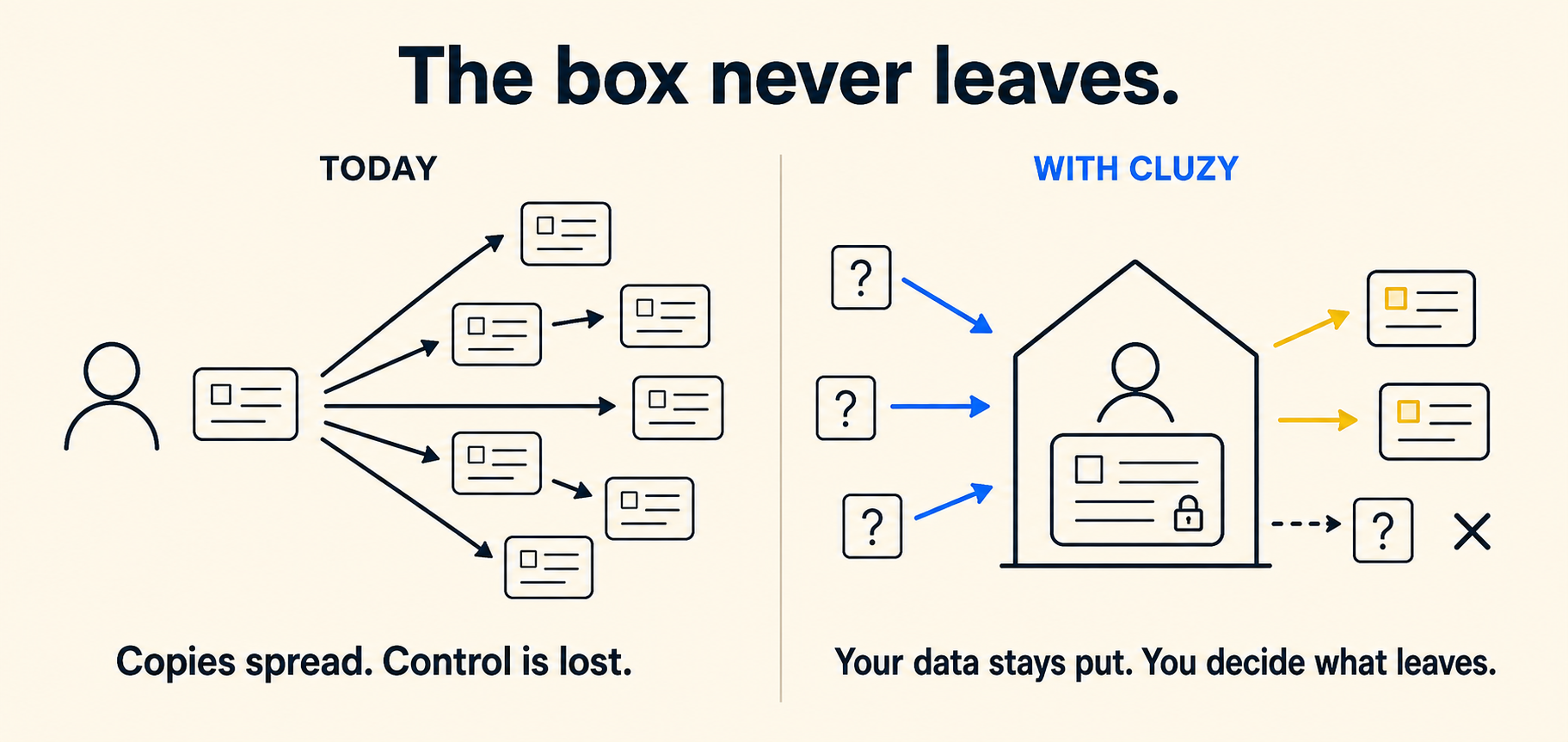
These are Dāginty’s central arguments. They should appear in company interviews, presentations and background conversations.
Privacy law gave people tools to restrict access. Trusted human data also requires people to take ownership of what describes them, correct it, maintain it and decide how it can be used. Dāginty provides the incentive through greater control, reduced exposure and participation in the value their data creates.
Cluzy is designed to collect information people provide directly, on their own terms, with permission and origin attached. The same program can help remove employee information from broker files that can make phishing, social engineering and help-desk impersonation more convincing. Security spending funds cleaner, permissioned inputs.
Where did it come from? Did a verified human provide it? Was it permissioned? What uses are allowed? Who has access? Can the individual control it? Dāginty’s model is designed to carry answers to all six with the record.
Beginning August 1, 2026, registered California data brokers must access the state’s Delete Request and Opt-Out Platform at least once every 45 days and process qualifying requests. They must direct associated service providers and contractors to delete covered personal information. A broker that fails to comply can face a $200 administrative fine for each deletion request for each day the violation continues.
Cluzy is designed to support individuals as an authorized agent. Other states may take different approaches, so current legal claims should be reviewed before publication.
AI depends on the quality, context and legitimacy of its inputs. Permissioned human data with traceable provenance can reduce error propagation, bias and privacy risk while limiting correction and retraining work.
Dāginty plans to reach employees through employers and the MSPs serving businesses with up to 1,000 employees. The model enters through a security budget that already exists and connects personal-data exposure reduction with cleaner human data.
Panels are typically small, paid and self-selected. Loyalty data belongs to a brand. Dāginty’s model centers the individual and is designed to carry revocable permission and provenance with the record.
Do not state that data-protection obligations are avoided. The architecture is designed so Dāginty does not control the individual’s storage, and counsel should address controller and processor status. Solid Pods may be stored by third-party providers or on storage controlled by the individual; Dāginty does not own or control that storage.
A software-led employee benefit designed to help people identify and reduce personal-data exposure that can make phishing, impersonation and harassment more convincing.
A clean-human-data company building systems where information is knowingly provided, permissioned and connected to its provenance.
Use the files directly - no form, email capture or account required. SVG files scale cleanly for print and digital use.
SVG · transparent · light backgrounds
Download SVG ↓
SVG · transparent · dark backgrounds
Download SVG ↓
SVG · transparent · monochrome
Download SVG ↓
SVG · transparent · light backgrounds
Download SVG ↓
SVG · transparent · dark backgrounds
Download SVG ↓
SVG · transparent · product mark
Download SVG ↓Keep clear space around the mark. Do not stretch, rotate, recolor, outline or place it on a background that reduces contrast. Use the white + yellow version on dark fields and the full-color or black version on light fields.
Text-only biographies are provided here for accurate quotation and easy updating.
Michael leads Dāginty’s company strategy, clean-data infrastructure and commercialization. His work connects human participation, permission and provenance to practical products and enterprise data systems.
Graham leads product and technical development, translating Dāginty’s clean-human-data model into usable software, workflows and infrastructure.
Jay leads Cluzy’s human-centered narrative and managed-service-provider strategy, shaping how Employee Data Wellness is understood, piloted and brought to market.
David brings experience in operations, technology companies and scalable customer delivery.
Dāginty is building Cluzy Employee Data Wellness and validating the model with prospective managed-service-provider partners.
Cluzy Census and the Clean Human Data API are part of the enterprise roadmap; they are not presented as generally available products.
Dāginty publishes practical analysis on Data Wellness, human agency, exposure risk and cleaner data systems.
Browse company articles →No formal press releases are currently published on this site. When a release is approved, add it to the Articles hub, date it, and link it here without removing this historical record.
Articles now sit inside the Media Center for quick press access. The full archive remains available on its dedicated page, with current publishing also available through Dāginty on Substack.
Michelle leads media relations for Dāginty. She helps journalists, analysts and partners verify facts, reach the right company leader and understand what is available now versus in development.
Press phone: available upon request.Clear facts. Direct access. No inflated claims.
This page is the canonical web newsroom. Treat downloadable files as supporting assets, not the source of truth.
Publish the dated item in /articles, then add a short milestone and link here.
Update the file in /public/brand or /public. Preserve its filename to keep existing media links working.
When the product interface is approved, add light- and dark-mode screenshots here and label the release or build shown.
Keep “available,” “pilot stage” and “in development” labels attached to every relevant product claim.
Verify downloads, leadership roles, contact details, product status, published metrics and legal usage guidance.
Replace “available upon request” only after a direct press number is approved for public use.